Natural Collagen for Dogs: Food Sources, Bone Broth & Supplements Explained
By VeraPaws Editorial Team·16 min read
Quick Answer
Yes. Dogs can consume collagen naturally through animal foods containing skin, cartilage, tendons, bones and other connective tissues.
Bone broth can also contain collagen derived gelatin and amino acids released during cooking.
But natural food sources have one important limitation:
THE COLLAGEN AMOUNT IS DIFFICULT TO MEASURE AND REPEAT.
Research examining bone broth found substantial variation in its amino acid content, particularly when preparation methods differed.
The researchers concluded that bone broth was unlikely to provide a consistently reliable amount of the key amino acids supplied by measured collagen supplements used in research.
That study was conducted in a human sports nutrition context, not in dogs, but the variability point is useful when comparing food with a measured supplement.
Hydrolysed collagen powder takes a different approach.
Instead of relying on the unknown collagen content of a meal or batch of broth, it provides a defined amount of collagen peptides that can be measured and served consistently.
Natural food sources can contribute collagen. A supplement makes the collagen amount easier to measure and repeat.
Key Takeaways
Collagen occurs naturally in animal connective tissues including skin, bone, cartilage and tendons.
Meat and animal foods can therefore contribute collagen, but the amount varies according to the tissue and preparation.
Bone broth contains collagen derived components, but its amino acid concentration can vary substantially between recipes and products.
Bone broth is not the same thing as hydrolysed collagen peptides.
Cooking changes collagen structure and prolonged heating can convert collagen into gelatin.
Hydrolysed collagen is deliberately processed into smaller collagen peptides.
Canine research exists for collagen hydrolysates, although the evidence remains developing and dosing is not standardised across studies.
A collagen supplement should complement a nutritionally complete diet, not replace it.
Human broths containing onion, garlic or other Allium ingredients should not be given to dogs.
Dogs should not be given the cooked bones left after making broth.
Natural does not automatically mean better.
Supplement does not automatically mean better.
The useful question is what fits the dog’s overall diet and the routine you are trying to create.
Where Is Collagen Found Naturally?
Collagen is a structural protein.
That means it is particularly associated with tissues that need strength and structure.
Animal sources include:
skin
tendons
ligaments
cartilage
bone
other connective tissues
Food science literature describes skin, bone, cartilage and tendon as major animal collagen containing tissues.
This is important because not every piece of animal food contains the same amount of collagen.
A lean piece of muscle meat and a piece containing significant connective tissue are nutritionally different.
So saying:
“My dog eats meat, therefore my dog gets plenty of collagen.”
does not tell us very much about the actual collagen intake.
What Are Natural Sources of Collagen for Dogs?
Skin
Animal and fish skin contain collagen. Skin can therefore contribute collagen as part of food. Depending on the source, it may also contribute substantial calories and fat, so it should still fit appropriately within the dog’s total diet.
Connective Tissue
Tendons, ligaments and connective tissue surrounding muscle contain collagen. Long cooking methods often soften these tissues because heat alters and solubilises collagen.
Cartilage
Cartilage contains substantial collagen, including Type II collagen within articular cartilage. That does not mean feeding cartilage is equivalent to giving a measured undenatured Type II supplement. Processing, structure and dose all matter.
Bone
Bone contains collagen within its organic matrix. But that does not mean owners need to feed bones to provide collagen. Bones can create risks including dental injury and gastrointestinal problems.
Bone Broth
Long cooking can transfer collagen derived gelatin and amino acids from animal tissues into broth. Bone broth can therefore be part of the conversation. But its collagen content is much harder to quantify than many owners realise.
Is Bone Broth a Good Source of Collagen for Dogs?
It can be a food source of collagen derived components.
But I would not describe it as a predictable collagen dose.
A study examining different bone broths measured amino acids associated with collagen, including:
glycine
proline
hydroxyproline
hydroxylysine
The researchers found large variation between nonstandardised broths.
Standardised broth preparations also provided lower amounts of several key amino acids than the reference collagen supplement amount used for comparison.
Again, that was not a canine clinical trial.
It does not tell us that bone broth is bad for dogs.
It tells us something more useful:
A bowl of bone broth is not a standardised collagen dose.
Why Does Bone Broth Vary So Much?
Think about how broth is made.
Two batches can differ in:
animal source
amount of bone
amount of cartilage
amount of skin and connective tissue
water volume
cooking temperature
cooking time
dilution
straining
final concentration
Even if both are called bone broth, they may not provide the same nutritional composition.
That is one of the fundamental differences between food and a measured supplement.
FOOD CAN NATURALLY VARY. A SUPPLEMENT CAN PROVIDE A DEFINED SERVE.
Neither statement makes one automatically superior.
They simply describe two different ways of feeding.
What Happens to Collagen When You Cook It?
Cooking does not mean the collagen simply disappears.
Heat changes its structure.
As collagen is heated, its organised structure denatures.
With continued heating, collagen can solubilise and form gelatin.
That familiar jelly like texture you may see when a rich stock cools is related to gelatin.
Native Collagen
Retains its original larger structural organisation.
Gelatin
Collagen that has undergone substantial denaturation.
Hydrolysed Collagen
Collagen deliberately broken further into smaller peptides through controlled hydrolysis.
These are related materials.
They are not identical forms.
Is Gelatin the Same as Hydrolysed Collagen?
No.
Both come from collagen, but they have undergone different processing.
Gelatin results from partial denaturation and breakdown of collagen and has the familiar ability to form a gel.
Hydrolysed collagen is processed further into smaller peptides that disperse much more readily in liquids.
Food science literature distinguishes native collagen, gelatin and collagen peptides because their molecular structures and physical properties differ.
Bone broth, gelatin and hydrolysed collagen all begin with collagen, but they are not nutritionally identical products.
Food vs Bone Broth vs Hydrolysed Collagen at a Glance
Collagen Rich Foods vs Hydrolysed Collagen Powder at a Glance
Collagen Rich Foods
Hydrolysed Collagen Powder
Natural animal source?
Yes
Yes, depending on source
Contains collagen derived protein?
Yes
Yes
Amount easy to measure?
Usually no
Yes
Consistent batch to batch?
Variable
Designed to be consistent
Can fit into normal feeding?
Yes
Yes
Calories from other nutrients?
Often
Generally concentrated around collagen
Requires preparation?
Often
Minimal
Can provide a repeatable daily routine?
Harder to quantify
Yes
Swipe to compare →
Bone Broth vs Hydrolysed Collagen Powder at a Glance
Bone Broth
Hydrolysed Collagen Powder
Natural animal source?
Yes
Yes, depending on source
Contains collagen derived protein?
Yes
Yes
Amount easy to measure?
Usually no
Yes
Consistent batch to batch?
Variable
Designed to be consistent
Can fit into normal feeding?
Yes
Yes
Calories from other nutrients?
Can vary
Generally concentrated around collagen
Requires preparation?
Usually
Minimal
Can provide a repeatable daily routine?
Harder to quantify
Yes
Swipe to compare →
The main difference is not:
natural versus artificial.
Hydrolysed collagen is still derived from animal collagen.
The bigger difference is:
Our Approach
VARIABLE FOOD SOURCE VS MEASURED COLLAGEN SERVE.
Is Bone Broth Better Than Collagen Powder?
There is no good evidence supporting a universal statement that bone broth is better than hydrolysed collagen powder for dogs.
And the reverse should not be overstated either.
They serve different purposes.
Bone broth may be useful as:
part of food
a palatable liquid
something to mix into a meal
an occasional addition to a dog’s normal diet
Hydrolysed collagen powder makes more sense when your goal is:
knowing what the collagen ingredient is
measuring the amount
repeating the same routine each day
choosing a particular collagen source
using a targeted supplement formula
Bone broth is food. Collagen powder is a measured supplement.
That distinction is more useful than trying to make one defeat the other.
Does Bone Broth Contain Enough Collagen?
There is no standard answer.
That is the problem.
Without laboratory analysis, you generally do not know exactly how much collagen derived protein or specific collagen related amino acids are present in a homemade broth.
Relevant sports nutrition guidance notes that food composition databases do not provide enough collagen specific information to accurately calculate collagen intake from ordinary foods and also highlights the variability found in bone broth.
So avoid claims such as:
“One cup of homemade broth gives your dog X grams of collagen.”
Unless that particular broth has actually been analysed, we simply do not know.
Can You Make Bone Broth for a Dog?
You can prepare a simple broth for a dog, but it needs to be dog appropriate.
One of the biggest issues with ordinary human broth is the ingredient list.
Avoid Onion and Garlic
Onion, garlic, leeks and chives belong to the Allium family.
Dogs can develop red blood cell damage after sufficient exposure, and toxicity has occurred from raw, cooked and concentrated forms.
That means:
Our Approach
DO NOT ASSUME A SUPERMARKET BROTH OR LEFTOVER HUMAN STOCK IS DOG SAFE.
Check the ingredients.
Keep the Recipe Simple
Avoid unnecessary:
seasoning
onion
garlic
heavily salted flavourings
sauces
Remove the Bones
The bones used to make the broth should not become the dog’s chew after cooking.
Cooked bones can splinter and cause gastrointestinal injury or obstruction.
Veterinary guidance also cautions about risks associated with raw bones.
Our Approach
MAKE THE BROTH FOR THE DOG.
DO NOT FEED THE LEFTOVER COOKED BONES.
What About Store Bought Bone Broth?
Read the label.
The words:
bone broth
do not make a product suitable for dogs.
Check for:
onion
garlic
leek
chives
added seasonings
sodium
other ingredients your dog should not receive
A product formulated specifically for dogs may make this simpler, but the ingredient panel still matters.
Can Food Provide Everything a Dog Needs for Collagen Production?
Dogs obtain amino acids through dietary protein and use nutrients from the overall diet to build and maintain their own body proteins.
That is another reason not to treat collagen as though it operates outside normal nutrition.
A dog’s primary diet should remain nutritionally complete and balanced.
Adding large amounts of human food, broth, skin or other extras can dilute that nutritional balance and add calories.
Relevant veterinary nutrition guidance commonly recommends that treats and extras make up only a small proportion of daily calories unless a veterinary professional advises otherwise.
Collagen should sit within good nutrition, not replace it.
So Why Use a Collagen Supplement at All?
This is where the VeraPaws position becomes very simple.
It is not because:
dogs cannot get collagen from food.
They can.
It is because food makes the amount difficult to know.
A supplement allows the owner to know:
the collagen source
the collagen form
the formula
the daily amount
how the serving changes according to the dog
That creates a much more repeatable routine.
Food can contribute collagen. A supplement lets you measure the routine.
What Is Hydrolysed Collagen?
Hydrolysed collagen is collagen that has been deliberately broken into smaller peptides.
After oral consumption, collagen hydrolysates are digested and absorbed primarily as amino acids and smaller peptides.
A recent veterinary review identified several canine studies investigating collagen hydrolysates for dogs with osteoarthritis.
The authors described the evidence as promising but also emphasised that studies use different preparations and doses and that more high quality clinical research is required.
This matters because hydrolysed collagen is not simply:
“powdered bone broth.”
It is a more controlled collagen ingredient with defined processing and composition.
Is Hydrolysed Collagen More Natural?
I would not use that argument.
Natural is one of those words that sounds useful but often tells you very little.
Bone broth is made by processing animal tissues with prolonged heat.
Gelatin is processed collagen.
Hydrolysed collagen is processed collagen.
The useful questions are:
What is the source?
What processing has been used?
What does the final ingredient contain?
How much is being served?
Does it suit the dog?
Natural is not a measurement of quality.
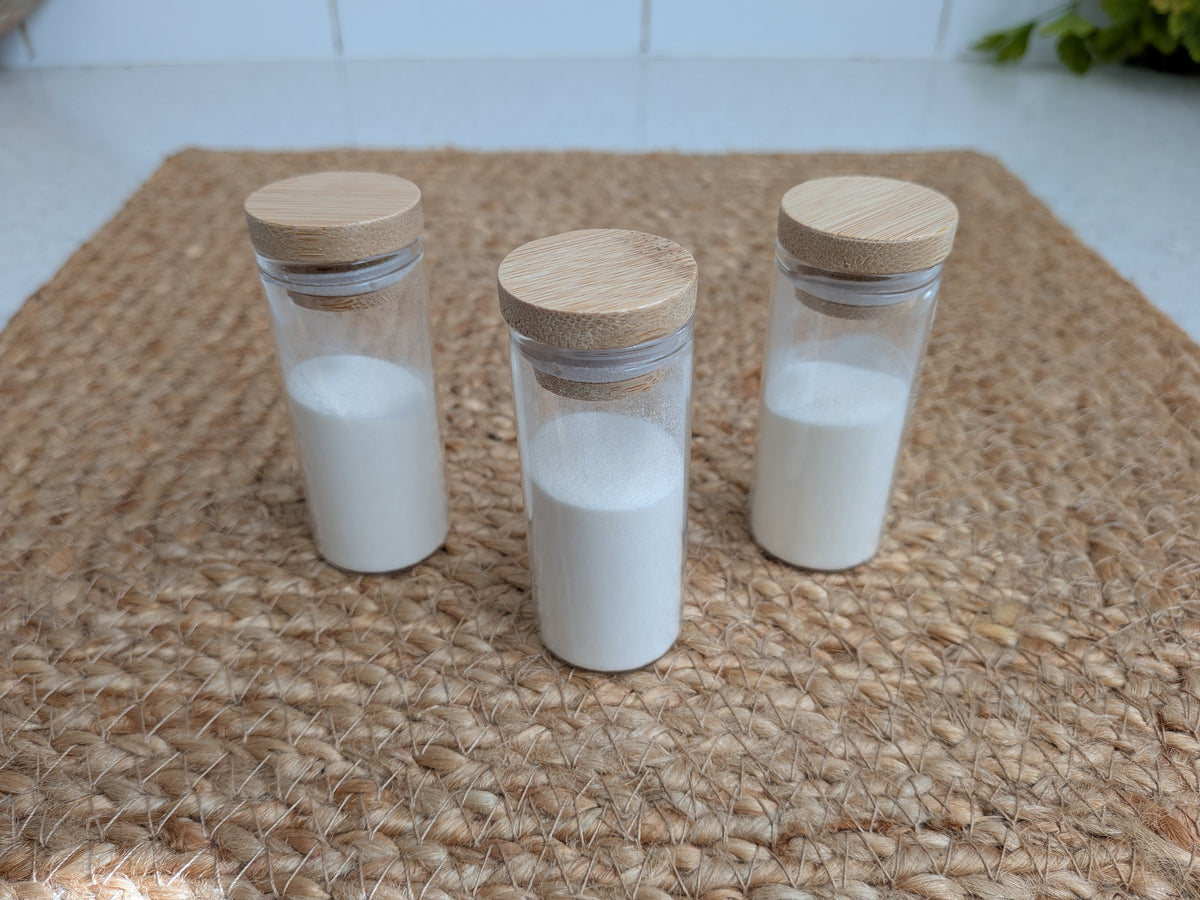
100% HYDROLYSED COLLAGEN PEPTIDES
The collagen combines Australian grass fed hydrolysed bovine collagen with wild caught marine collagen peptides made in Australia.
There are no targeted joint or skin ingredients added to the formula.
It is our straightforward everyday collagen routine.
Collagen first. Nothing complicated.
Food First or Supplement First?
They do not have to be opposing philosophies.
A dog can eat a nutritionally balanced diet.
They can occasionally enjoy suitable whole foods.
They can have a dog appropriate broth.
And an owner can still choose a measured collagen supplement.
The supplement is not replacing food.
It is providing a specific ingredient in a repeatable amount.
FOOD IS THE FOUNDATION.
THE SUPPLEMENT IS THE ROUTINE YOU ADD AROUND IT.
What If My Dog Already Eats Lots of Collagen Rich Food?
That does not automatically mean you need a supplement.
If you are happy with your dog’s diet and you are not trying to create a specific collagen routine, there is no rule saying every dog needs collagen powder.
If you are deciding whether supplementation makes sense, consider:
what you are trying to support
how consistent the dog’s current food intake is
whether you want a measured daily amount
the dog’s overall diet
health conditions
other supplements already being used
The decision should have a purpose.
What About Bone Broth and Joint Support?
Bone broth is often marketed around joints because it contains collagen related amino acids and gelatin.
But we should separate:
contains collagen derived nutrients
from:
clinically demonstrated joint supplement dose.
The bone broth research discussed earlier found considerable variability in key amino acid concentrations.
By comparison, canine joint research involving collagen hydrolysates uses defined collagen preparations and known study doses.
So if joint support is the objective:
A measured collagen supplement gives you a more defined nutritional routine than an unanalysed bowl of broth.
That is not the same as saying broth has no nutritional value.
Again, the difference is formulation and repeatability.
Can I Use Bone Broth With VeraPaws Collagen?
For most healthy dogs, a suitable dog appropriate broth can simply be part of how you serve the powder.
You do not need to choose:
broth or collagen.
For example:
Add the VeraPaws daily serve to the bowl.
Mix it with a small amount of suitable broth.
Stir.
Add it to the dog’s meal.
Powder when stored. Liquid when served. Fresh every time.
Just remember that any broth adds to the dog’s overall diet and should use dog appropriate ingredients.
What Should You Compare?
The Collagen Source
Skin?
Connective tissue?
Bone broth?
Bovine collagen?
Marine collagen?
The Form
These are related but not identical.
Food collagen?
Gelatin?
Hydrolysed peptides?
The Amount
Can you actually tell how much collagen your dog receives?
Consistency
Will tomorrow’s serving be similar to today’s?
The Rest of the Diet
Does the addition fit within a complete and balanced feeding routine?
Extra Ingredients
For broth in particular, check for onion, garlic and unnecessary seasoning.
Safety
Do not turn collagen seeking into unsafe bone feeding.
Purpose
Are you simply adding a nutritious food, or are you trying to establish a measurable daily collagen routine?
The more specific the goal, the more useful a measurable serve becomes.
Natural Food vs Bone Broth vs Supplement: Which Should You Choose?
Choose Whole Foods When
You simply want suitable animal foods to form part of a broader diet.
Choose Bone Broth When
You want a palatable dog appropriate food addition and understand that the collagen amount will vary.
Choose Hydrolysed Collagen When
You want a defined collagen ingredient and a repeatable daily serve.
These choices can overlap.
They are not mutually exclusive.
What Australian Dog Owners Should Remember
Collagen Exists Naturally in Food
Particularly in animal connective tissues.
Bone Broth Can Contain Collagen Derived Nutrients
But the amount is difficult to predict.
Cooking Changes Collagen
Long heating can convert collagen into gelatin.
Gelatin and Hydrolysed Collagen Are Different
They come from collagen but are processed differently.
Natural Does Not Automatically Mean Better
Evaluate the actual food or ingredient.
Bones Are Not Required
Do not create an injury risk simply to provide collagen.
The Main Diet Still Matters
Collagen additions should sit within appropriate overall nutrition.
A Supplement Makes the Routine Measurable
You know what you are serving and can repeat it consistently.
Food can provide collagen. A measured supplement provides a repeatable collagen routine.
Frequently Asked Questions
What foods naturally contain collagen for dogs?
Collagen occurs naturally in animal connective tissues including skin, cartilage, tendons, ligaments and bone.
The amount varies considerably according to the food and tissue.
Is bone broth a good source of collagen for dogs?
Bone broth can contain collagen derived gelatin and amino acids.
However, research has shown that amino acid concentrations can vary substantially between bone broth preparations, so it should not be considered a standardised collagen dose.
Is bone broth better than collagen powder?
Not automatically.
Bone broth is a food, while hydrolysed collagen powder provides a more defined and measurable collagen ingredient.
The right choice depends on what you are trying to achieve.
Can dogs have human bone broth?
Check the ingredient list carefully.
Human broths commonly contain ingredients such as onion or garlic, which can be toxic to dogs.
A simple dog appropriate broth is the better choice.
Can dogs eat the bones after I make bone broth?
No.
Cooked bones can splinter and may cause gastrointestinal injury or obstruction.
Veterinary guidance also cautions about risks associated with feeding bones.
Does cooking destroy collagen?
Cooking changes the collagen structure rather than simply making it disappear.
With heat and prolonged cooking, collagen can denature and solubilise into gelatin.
Is gelatin the same as collagen?
Gelatin is derived from collagen that has been denatured.
Hydrolysed collagen has been processed further into smaller peptides, so the two are related but are not identical forms.
Is chicken skin a natural source of collagen?
Animal skin contains collagen.
However, the actual collagen amount and overall nutritional profile vary, so it is not equivalent to a measured collagen supplement.
Does my dog need collagen supplements if they eat meat?
Not necessarily.
There is no rule that every dog eating a normal diet needs supplemental collagen.
A supplement becomes useful when an owner wants a specific, measurable and repeatable collagen routine.
Can I mix collagen powder with bone broth?
Yes, provided the broth is appropriate for your dog.
VeraPaws collagen powder can be mixed into a small amount of suitable broth and then added to the meal.
Which VeraPaws collagen is best for everyday use?
Premium Collagen For Dogs is the straightforward everyday collagen formula.
It contains 90% hydrolysed bovine collagen peptides and 10% hydrolysed marine collagen peptides.
Which VeraPaws collagen should I use for joints?
Hip & Joint Collagen For Dogs is the targeted movement formula.
It uses an 88% hydrolysed collagen foundation with MSM, glucosamine sulphate and chondroitin sulphate.
VeraPaws gives you a simple way to know what you are adding each day, with Australian collagen, transparent formulas and serving based on your dog’s body weight.